
KSE held discussions with David O’Sullivan, EU Special Envoy for Sanctions, and Ukraine’s expert community on further pressure on Russia
9 July 2026
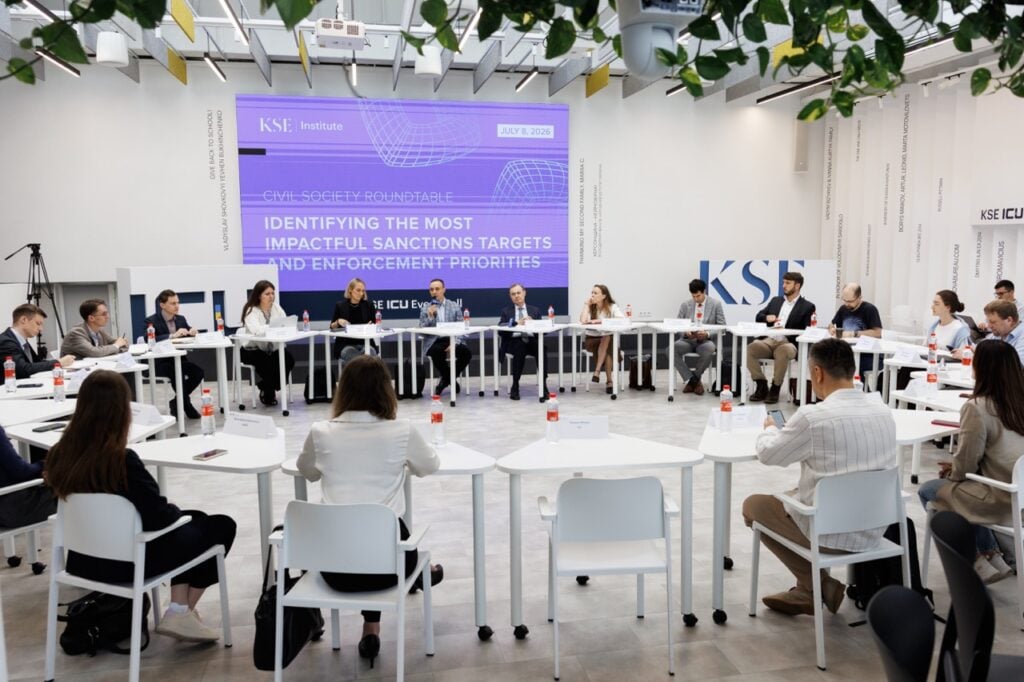
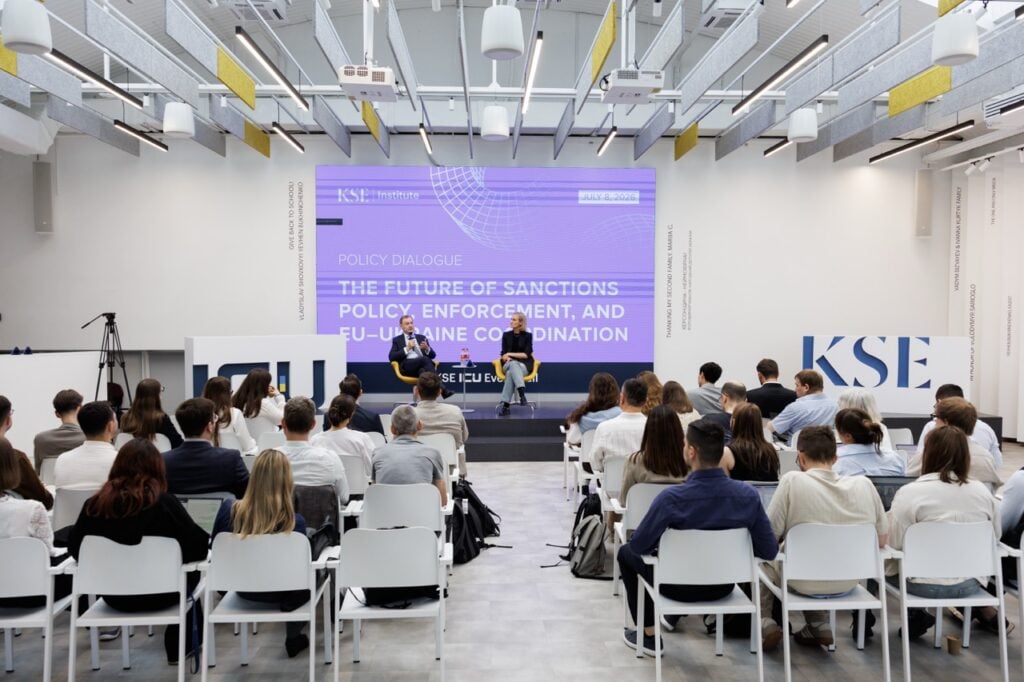
On 8 July, KSE hosted David O’Sullivan, the EU Special Envoy for the Implementation of EU Sanctions. The KSE Institute Sanctions Hub of Excellence brought together Ukrainian civil society organisations, researchers, and EU representatives for two discussions on how Russia circumvents sanctions, where pressure can be strengthened, and how Ukraine, the EU, and allies can better coordinate their actions.
At the roundtable “Identifying the Most Impactful Sanctions Targets and Enforcement Priorities,” Ukrainian civil society organisations shared their research findings and evidence on specific cases of sanctions circumvention with the EU Special Envoy. Vladyslav Vlasiuk, Advisor – Commissioner of the President of Ukraine for Sanctions Policy, also joined the discussion and outlined Ukraine’s priorities for strengthening sanctions pressure.
David O’Sullivan identified three priority areas for sanctions work – foreign components, financial channels, and Russia’s energy revenues. He described restricting Russia’s access to components as one of the main priorities.
Foreign components and technologies that Russia continues to obtain for military production were among the main topics of the roundtable. Researchers presented evidence on components found in Russian missiles and drones, computer numerical control machines, and other industrial equipment. EU representatives were given the names of specific Western companies whose products or technologies are reaching Russian supply chains, including those used in weapons production.
The discussion also covered strategic and critical materials and civilian companies helping Russia expand its domestic industrial capacity. Researchers also highlighted gaps in corporate compliance – when some intermediaries are sanctioned, new entities emerge in supply chains, while some manufacturers fail to respond adequately to evidence that their products are reaching Russia.
On finance, David O’Sullivan stressed the need to identify and counter complex payment schemes, the use of cryptocurrencies, and parallel payment systems. On energy, he called for greater pressure on buyers of Russian oil, refineries in third countries, and the shadow fleet.
Yuliia Pavytska, Head of the KSE Institute Sanctions Hub of Excellence, noted that the EU ban aimed at closing the “refining loophole” has already produced tangible results. According to KSE Institute estimates, following its introduction, EU imports of petroleum products from the 11 refineries analysed, which used Russian crude oil and supplied petroleum products to the European market, fell by 69%. This confirms the effectiveness of the restriction. At the same time, certain refineries require closer scrutiny to ensure compliance with the ban.
The roundtable also covered the LNG fleet, Russian banks, asset confiscation, and accountability for sanctions violations. Participants proposed increasing pressure on banks that facilitate payments for imports of critical components and exploring mechanisms to direct confiscated assets and funds recovered from sanctions violations towards Ukraine’s needs.
During the second part of the visit, David O’Sullivan joined the policy dialogue “The Future of Sanctions Policy, Enforcement, and EU–Ukraine Coordination,” moderated by Nataliia Shapoval, President of KSE Institute. The discussion covered joint sanctions action by the EU, Ukraine, and allies, including the United Kingdom and the United States, as well as the EU’s next decisions and priorities for the 21st sanctions package.
Among the most debated issues were the future of the oil price cap, a maritime services ban, EU sanctions against Rosatom, and further pressure on Russia’s energy sector. Participants also discussed the enforcement of existing sanctions and further alignment of sanctions action among allies.
The KSE Institute Sanctions Hub of Excellence thanks ANTS, B4Ukraine, Don’t Fund Russian Army, ESCU, ILI, NAKO, Razom We Stand, and StateWatch for their research, concrete cases, and participation in the roundtable.
KSE Institute also thanks David O’Sullivan and the representatives of the European Union for the open dialogue, their willingness to engage with Ukraine’s expert community, and their unwavering support for Ukraine.