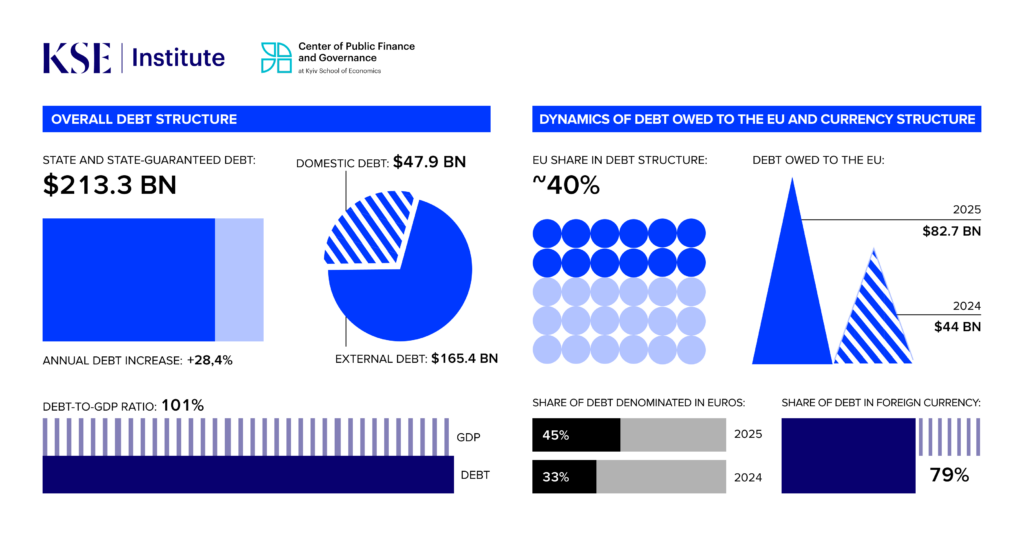
According to the 2025 State Debt Review by the KSE Institute’s Center for Public Finance and Governance Analysis, Ukraine’s state debt increased to USD 213.3 billion by the end of 2025, or nearly 101% of GDP. Over the year, state debt grew by USD 47.2 billion, or 28.4%. The primary driver of this increase was external borrowing. External debt rose by almost 40% to USD 160.4 billion, while domestic debt increased more modestly to USD 46.4 billion.
In 2025, state budget expenditures amounted to USD 131.3 billion, of which USD 73.6 billion was allocated to defense. Domestic revenues covered only about 60% of expenditures. The budget deficit, even including grants, stood at USD 39.2 billion, and without grants it reached USD 52.4 billion. Ukraine received USD 13.1 billion in non-repayable assistance, while the remaining financing needs were covered mainly through external loans.
Under the ERA program, Ukraine received nearly USD 38 billion in 2025, including USD 25.9 billion in loans and USD 12.1 billion in grants. Servicing and repayment of these loans will be financed through proceeds generated from Russian assets. Formally, these loans increase state debt, but they do not create the same direct debt burden on the budget as traditional borrowing. ERA loans already account for about 17.8% of total public debt.
The second most significant source of support was the European Union’s Ukraine Facility program, under which Ukraine received USD 11.8 billion. However, due to the incomplete fulfillment of certain reform commitments, the country failed to receive approximately USD 2 billion.
The EU has effectively become Ukraine’s main creditor. Debt owed to the European Union increased from USD 44 billion in 2024 to USD 82.7 billion in 2025, while its share in the state debt structure reached around 40%. This substantially altered the currency composition of the debt: the share denominated in euros increased from 33% to 45%, while the share in U.S. dollars declined to 23%. Overall, 79% of state debt is now denominated in foreign currency. At the end of 2025, the EU also approved a new Ukraine Support Loan instrument worth EUR 90 billion for 2026–2027. Its repayment is expected to occur only after Ukraine receives reparations from Russia.
Demand for domestic government bonds increased throughout the year. Banks remained the largest investors, holding around 48% of the domestic government bond portfolio. Holdings by individuals grew the fastest, increasing by 42.5%. The share held by the National Bank declined to 35%, indicating a gradual reduction in the budget’s dependence on monetary financing. Conversely, the share of foreign investors fell to 0.8%.
The government also implemented several important debt management measures. The most significant was the restructuring of GDP warrants — instruments whose payments were linked to economic growth and which could have created substantial fiscal risks. Warrants worth USD 2.6 billion were exchanged for new bonds with fixed parameters. According to estimates by Ukraine’s Ministry of Finance, this will help avoid potential payments ranging from USD 6 billion to USD 20 billion during 2025–2041. In 2025, Ukraine also conducted its first domestic bond exchange operation worth USD 0.8 billion to smooth future repayment obligations.
According to KSE Institute forecasts, public debt may peak at around 110% of GDP in 2027, after which it is expected to gradually decline. To strengthen the debt management system, the government approved the Medium-Term Public Debt Management Strategy for 2026–2028 in December 2025. In parallel, the public finance management reform strategy envisages the establishment of a separate Debt Management Agency by 2027. These measures aimed at ensuring Ukraine’s long-term debt sustainability and fiscal resilience.