- Kyiv School of Economics
- About the School
- News
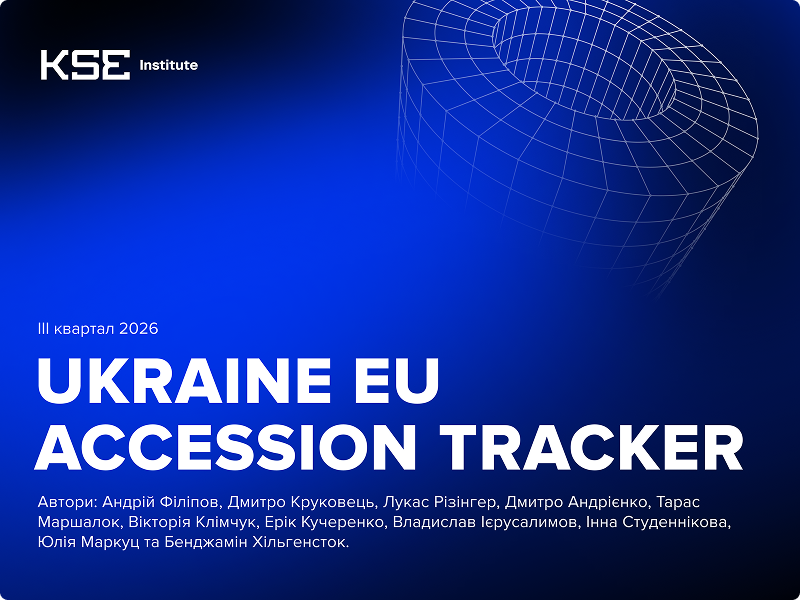
- Ukraine opens its second negotiating cluster, but the further pace of EU accession depends on the implementation of reforms dynamics— Ukraine EU Accession Tracker by KSE Institute
Ukraine opens its second negotiating cluster, but the further pace of EU accession depends on the implementation of reforms dynamics— Ukraine EU Accession Tracker by KSE Institute
24 September 2026
In Q3 2026, Ukraine continued to advance in its EU accession negotiations: on July 14, Cluster VI, “External Relations,” was formally opened, becoming the second open cluster. Measurable progress on chapters and legislation contrasted with slower delivery on rule-of-law commitments. Read more about these and other aspects of Ukraine’s EU integration process in the new edition of the Ukraine EU Accession Tracker by KSE Institute, which assesses the progress of negotiations, reform implementation, legislative developments, EU financial support, and political factors shaping the accession process.
At the same time, Hungary’s blockade has not disappeared. Budapest refused to approve the opening of Cluster II, “Internal Market,” and Cluster III, “Competitiveness & Inclusive Growth.” Hungary links its position to the implementation of agreements on the rights of the Hungarian national minority, meaning progress on these clusters currently depends on a political decision in Budapest.
Following the July change of government, nine EU-integration bills linked to Ukraine Facility indicators were automatically removed from the Verkhovna Rada’s agenda. Seven have since returned to Parliament: three were re-registered by the new Cabinet, while four returned through parallel MP or committee bills. Two still have no replacement in the Rada. Among other accession-related legislation, the draft Labour Code had still not been resubmitted as of mid-September. The July reshuffle did not alter Ukraine’s strategic course on EU integration: the new government remains committed to opening all six negotiating clusters and completing negotiations by the end of 2027.
Progress on rule-of-law commitments remains slow. Only one of the ten points in the Kachka–Kos plan has been fully completed: legislation on judges’ integrity declarations and the enforcement of court decisions has been adopted. At the same time, Constitutional Court appointments, merit-based prosecutor selection, changes to the procedure for appointing and dismissing the Prosecutor General, and State Bureau of Investigation reform remain incomplete. The Anti-Corruption Strategy is also yet to reach a floor vote.
Two anti-corruption cases could negatively affect the rule-of-law assessment, negotiations under the “Fundamentals” cluster, and, in particular, fulfillment of conditions under Chapters 23 and 24. These are a NABU investigation into an alleged criminal organization involving MPs and officials of the Office of the President, as well as a NABU and SAP case involving Prosecutor General’s Office officials suspected of protecting fraudulent call centers.
There was nevertheless some progress on reform-related legislation during the quarter. Six of the 11 priority laws identified in EU Enlargement Commissioner Marta Kos’s letter have now been adopted and signed, and two more are awaiting signature. These include legislation on the enforcement of court decisions, judges’ integrity declarations, railway safety and interoperability, and district heating. However, the more difficult reforms are moving more slowly. The bill on NEURC independence passed first reading only on September 16 after nine months in committee. State-aid control and the restoration of civil-service competitions also remain at the first-reading stage.
EU financial support is provided through three tracks, two of which are conditional on reform delivery. The Macro-Financial Assistance track totals €8.35 billion: Ukraine received €3.2 billion in June, while the next €3.7 billion installment depends on meeting 12 conditions. Because some legislative requirements were not met by August 31, the payment is now delayed until at least Q4.
Following the revision of the Ukraine Facility, its total payment envelope increased to €40.9 billion, while 27 new reform steps were added. As of mid-September, Ukraine had received €21.6 billion in seven installments, while €1.7 billion from previous payments had been withheld due to unmet commitments. For the eighth payment, the European Commission proposed another €3.05 billion. In a best-case scenario, Ukraine could complete the remaining Kachka–Kos commitments by the end of 2026 while making further progress on overdue and newly added Ukraine Facility reforms. Some Facility requirements, however, fall due only after 2026.
The third track, the €28.3 billion Ukraine Support Loan for defense, is not conditional on reform delivery. The European Commission has already assigned the full amount to specific procurement plans. So far, €8.4 billion has been disbursed, while the remaining €20 billion will be released as the relevant contracts are signed and verified.
The further pace of Ukraine’s EU accession will depend on its ability to complete reforms within the agreed deadlines. The main priorities for the end of 2026 remain reforms in the prosecution and anti-corruption areas, completion of key legislative changes, and fulfillment of the conditions tied to European financing.