
The Ukrainian defense technology market: opportunities for investors — KSE Institute report
31 March 2026
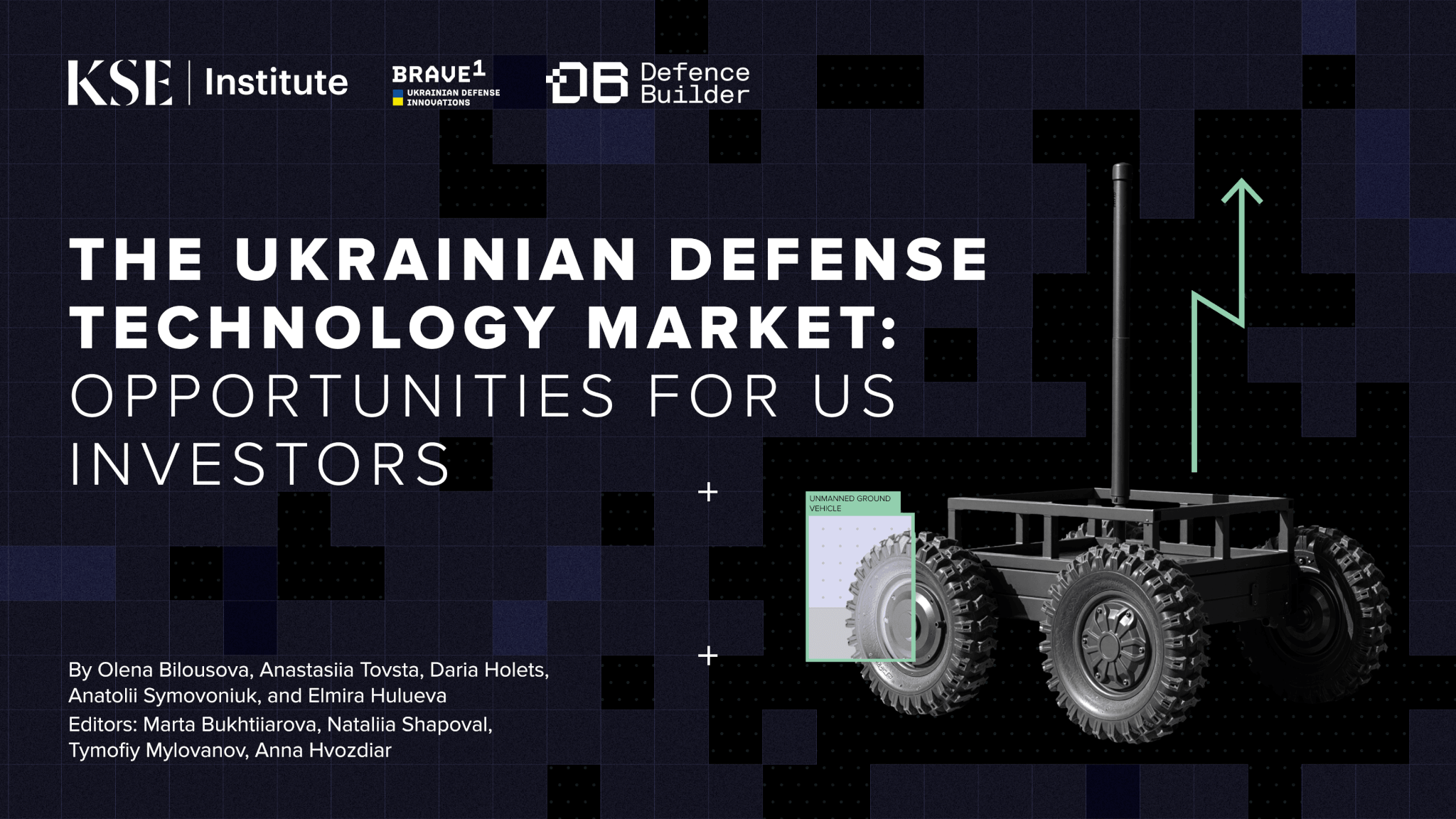
KSE Institute, in collaboration with Brave1 and Defence Builder, has presented a new study examining how, in the context of Russia’s full-scale invasion, Ukraine’s defense technology sector has emerged as one of the most dynamic segments of the economy — and what opportunities it creates for U.S. and international investors.
In 2025, the Ukrainian defense technology market reached an estimated $6.8 billion. At the same time, total defense output expanded at a slower pace due to constrained domestic procurement financing. In contrast, high-technology segments grew significantly faster: UAV production increased by 137%, unmanned ground vehicles (UGVs) by 488%, and electronic warfare (EW) systems by 215%. The actual market size is likely higher, as a substantial share of procurement takes place through decentralized channels — including volunteer funding, direct unit-level contracting, and in-house production within military brigades — which remain outside formal statistics.
The study identifies three key segments with the strongest investment potential:
• The UAV segment is the largest and most mature, reaching $6.3 billion in output in 2025. The fastest growth is observed in deep-strike drones and interceptor systems, while FPV drones remain the dominant mass segment. Key areas of opportunity include interceptor drones at an early scaling stage, middle-strike systems, and domestically produced ISR multicopters to replace reliance on Chinese DJI platforms.
• Unmanned ground vehicles (UGVs) represent a segment that is still forming but expanding rapidly from a low base, reaching $252 million in 2025 — a sixfold increase year-on-year. Growth is driven primarily by logistics and evacuation platforms, which are already scaling and addressing immediate operational needs. Strike and demining systems are opening additional niches with strong long-term demand.
• Electronic warfare (EW) serves as a critical enabler across all defense technologies, reaching $220 million in 2025 with 3.1x year-on-year growth. The market is shifting from fragmented experimentation toward scaled production of proven solutions, with increasing focus on software-defined “smart EW” systems capable of signal analysis and targeted jamming.
Technological development is concentrated around four core areas: EW-resilient, multi-layered communications; GPS-denied navigation based on inertial systems and AI-driven visual positioning; autonomy, including automatic target recognition and coordinated strike capabilities; and integration — the evolution from standalone products to networked, interoperable systems that can be rapidly adapted to new operational requirements.
In 2025, Ukrainian defense technology companies and startups attracted approximately $129 million in investments and grants — a conservative estimate, as a portion of deals remains undisclosed for security reasons. Investment activity is concentrated in AI and software segments, which offer greater scalability and fewer regulatory constraints. Key financing mechanisms include Brave1 grants (over $60 million in 2025, supporting more than 600 companies), venture capital, concessional loans under the “5–7–9” program ($160 million for 108 enterprises), and partner-country financing through direct procurement mechanisms. Companies that secured funding demonstrated rapid growth in production capacity.
To structure investment decisions, the study proposes a framework based on Technology Readiness Levels (TRLs). At early stages (TRL 1–5), R&D partnerships and SAFE-type instruments are most relevant; at intermediate stages (TRL 5–7), equity investments and SPV structures; and at advanced stages (TRL 7–9), debt financing and growth capital.
The strategic partnership between Ukraine and the United States, anchored in a ten-year security agreement and multi-year funding mechanisms, provides a stable foundation for deeper industrial cooperation. The long-term potential for Ukraine’s recovery and defense sector development over a ten-year horizon following the end of hostilities is estimated at $690 billion.
According to KSE Institute, Ukraine’s defense technology sector has evolved into one of the most dynamic innovation ecosystems globally — driven by battlefield-tested technologies, rapid development cycles, and an expanding financing infrastructure. For investors, this represents an opportunity to engage with solutions that have proven effectiveness in real-world conditions and strong potential for scaling in international markets.