
Russian Oil Tracker – June 2026: Russia ramps up crude exports after refinery strikes, as a shadow fleet shortage deepens its reliance on Western maritime services
1 July 2026
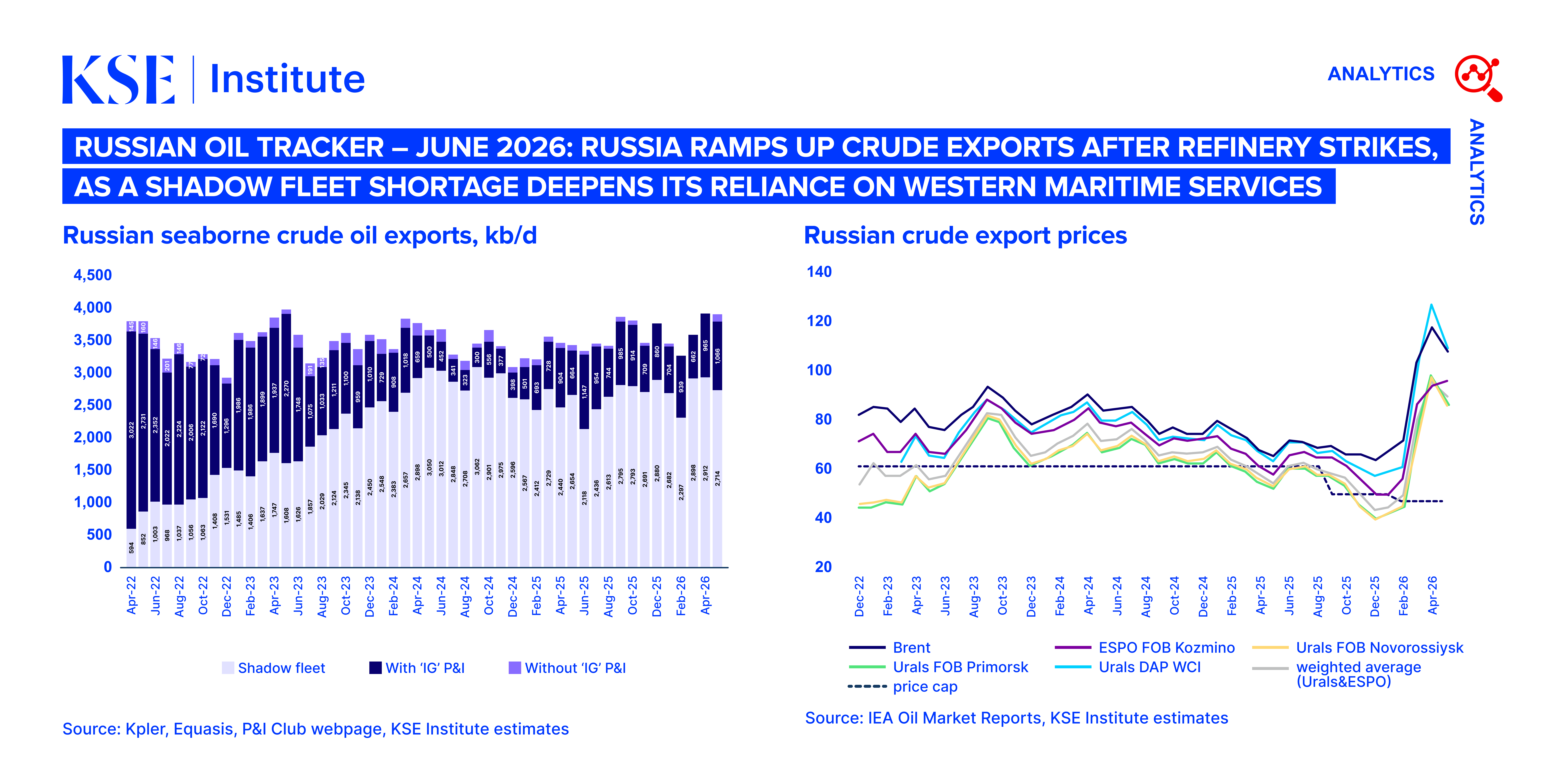
In May 2026, Russian seaborne oil exports decreased by 2.5% month-over-month (m-o-m) but increased by 1.5% year-over-year (y-o-y), according to the June edition of the Russian Oil Tracker by KSE Institute. Seaborne crude oil exports remained broadly stable at 3.88 mb/d, while seaborne oil product exports declined to 1.89 mb/d after the suspension of loadings from Tuapse. In April 2026, Russian oil export revenues declined by $0.7 billion m-o-m to $20.8 billion, $8.2 billion higher y-o-y.
Russian reliance on Western maritime services increased to 42% in May, IG P&I-insured tankers carried 27% of crude and 73% of oil products. Following Ukrainian drone strikes on refineries, Russia was forced to export more crude due to lower refinery runs , but its shadow fleet was insufficient for the additional volume. Together with a US waiver that allowed insured tankers to complete shipments already under way, this pushed Russia toward greater use of Western maritime services in April and May.
Average Urals FOB prices decreased by ~$11.5/bbl to ~$85/bbl, still trading well above the EU’s revised price cap, while ESPO FOB Kozmino increased by ~$2.3/bbl to around $95/bbl. Prices for almost all oil products except vacuum gasoil also traded above their respective caps. Even so, the cargoes kept moving, largely on tankers operated by Greek and other European companies — five of the ten largest crude carriers and seven of the ten largest oil product carriers in May were Greek.
The shadow fleet remained central to exports. KSE Institute estimates that 185 loaded shadow fleet tankers carrying crude and oil products left Russian ports or were involved in STS transfers in May, 92% of them older than 15 years.
As of June 17, 2026, the US, UK, EU, Australia, Canada and New Zealand had jointly sanctioned 653 unique oil tankers, including a further 71 and 23 vessels designated in June by the UK and Canada, respectively. Many sanctioned vessels nonetheless continue to carry Russian oil.
In May, US-designated producers Rosneft, Lukoil, Gazpromneft and Surgutneftegaz restored their share in crude oil exports to 61%, following a decline to 4–8% in January–March 2026, while the share of the UAE-based companies Redwood Global Supply FZE LLC and Alghaf Marine DMCC dropped to 14% from 33% in April.
India, China and Turkey remained the main buyers. India increased imports of Russian crude oil by 23% to 1.9 mb/d, China reduced imports by 10% to 1.2 mb/d, and Turkey cut imports to 130 kb/d, the lowest level since the invasion.
The KSE Institute revised its projected Russian oil export revenues after the announcement of fragile truce between the US and Iran. In the base case, with current price caps and the status quo of sanctions, revenues will increase from $158 billion in 2025 to $183 billion in 2026. Under increasing sanctions pressure, revenues are expected to rise only modestly, to $162 billion, while under weak sanctions enforcement they could reach $193 billion. Total Russian oil export losses since March 2022 are estimated at $194.8 billion.