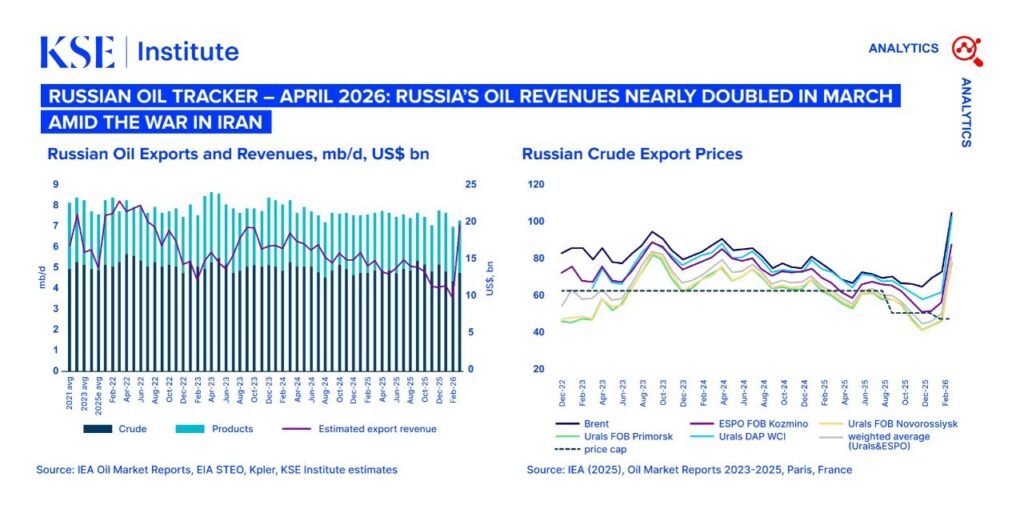
In March 2026, Russia’s oil export revenues surged by ~$9.3 billion month-on-month to $19.0 billion, according to the April edition of the Russian Oil Tracker by KSE Institute. The sharp increase was driven by the US-Israeli war with Iran, which pushed global oil prices sharply higher following the closure of the Strait of Hormuz. Crude export revenues increased by $5.4 billion to $11.45 billion, while oil product revenues rose by $3.9 billion to $7.59 billion.
Russian seaborne oil exports increased by 7.4% MoM but decreased by 1.6% YoY in March. Crude shipments rose by 8.9% and oil product shipments by 5.0%. Russia’s reliance on Western maritime services decreased to 39%, with IG P&I-insured tankers carrying 18% of crude and 72% of oil products.
The shadow fleet continues to play a central role in Russian oil exports. KSE Institute estimates 194 shadow fleet tankers carrying crude and oil products departed Russian ports or were involved in ship-to-ship (STS) transfers in March 2026, with 92% older than 15 years.
The share of sanctioned tanker-days increased from 15% in July 2025 to 32% in March 2026, while the corresponding share for US-designated tankers reached 28%, driven by the return of previously idle tankers to commercial service.
As of April 24, the US, UK, EU, Australia, Canada, and New Zealand jointly sanctioned 651 unique oil tankers, including 30 unique vessels added by the EU under its 20th sanctions package.
In the first half of April, US-designated producers Rosneft, Lukoil, Gazpromneft, and Surgutneftegaz restored their share in crude oil exports to 38%, following a decline to 5–11% in January–March 2026. Over the same period, the share of UAE-based companies Redwood Global Supply FZE LLC and Alghaf Marine DMCC eroded to 12%, from 42% in March 2026.
In March 2026, India’s imports of Russian crude oil rose to 1.9 mb/d, up 88% MoM, while China’s seaborne imports stood at 1.8 mb/d.
As of 16 April, volumes of Russian crude on the water declined by around 20% from the March peak to 125 million barrels, reflecting the completion of shipments following the US waiver for cargoes already in transit. Oil product volumes on the water also decreased by around 20%, from nearly 100 million barrels in March to 80 million barrels in April.
In Q1 2026, Russia established Idas LLC, controlling a fleet of 10 designated tankers previously operated by other designated companies, six of which have already conducted voyages from Russia under full Idas LLC control. Russia also engaged 12 shadow fleet tankers to load oil and oil products at its ports during Q1, seven of which had not loaded Russian oil in 2025 following US sanctions but resumed operations in 2026.
Average Urals FOB prices increased by ~$33/bbl MoM to ~$76/bbl in March, trading well above the EU’s revised price cap. ESPO FOB Kozmino increased by ~$31/bbl to ~$85/bbl. Prices for Russian diesel and gasoil rose to ~$144/bbl and ~$134/bbl respectively, while fuel oil prices nearly doubled to $61/bbl.
According to KSE Institute estimates, the Middle East conflict has prompted a revision of Russia’s oil revenue outlook. In the base case – current price caps, sanctions status quo, and a conflict lasting up to three months – revenues could increase from $158 billion in 2025 to $189 billion in 2026 and $161 billion in 2027. Under the optimistic scenario, with increasing sanctions pressure on Russian oil, revenues are expected to increase only modestly to $164 billion in 2026 and contract to $123 billion in 2027. In the most adverse scenario – weak sanctions enforcement – revenues could reach $244 billion in 2026 and $225 billion in 2027.