
Russia Chartbook by KSE Institute — Weak Revenues Put Severe Strain on the Budget; Economic Growth Stalls Amid Higher Inflation
5 March 2026
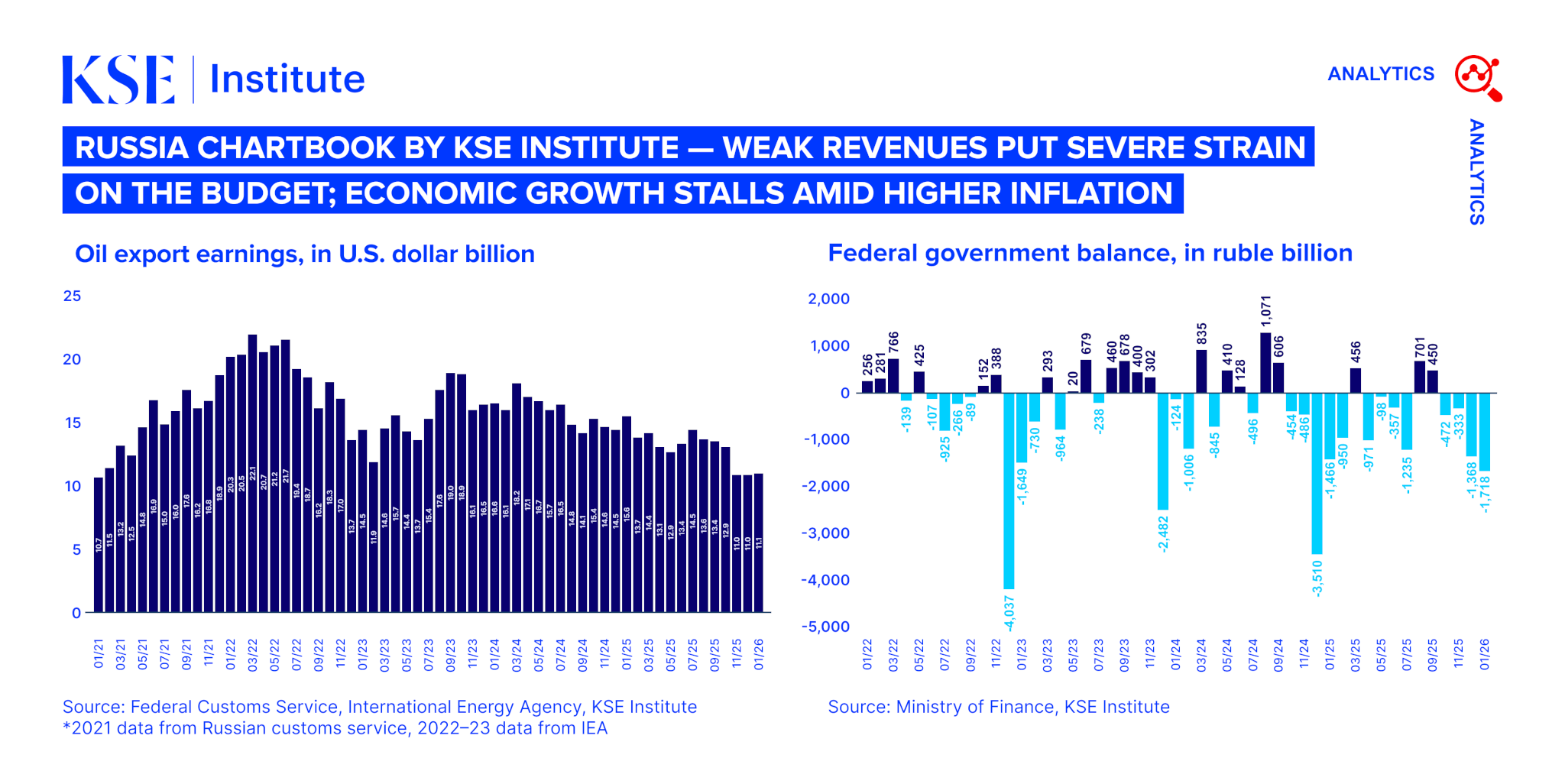
KSE Institute has published the February edition of its Russia Chartbook, “Weak Revenues Put Severe Strain on the Budget; Economic Growth Stalls Amid Higher Inflation.” The latest data point to growing fiscal pressure driven by declining energy revenues, rising debt, and accelerating inflation, further limiting Russia’s economic outlook.
Weak energy revenues have sharply worsened Russia’s fiscal position. In January 2026, the federal budget recorded a deficit of 1.7 trillion rubles — the highest January deficit on record. Oil and gas revenues fell to just 393 billion rubles, their lowest level in four years, reflecting persistently low export prices. While higher global oil prices due to geopolitical tensions may provide some temporary relief in the coming months, overall conditions remain challenging. Regional finances are also deteriorating, with the consolidated regional budget deficit reaching approximately 1.5 trillion rubles at the end of 2025.
To finance these deficits, Russia is increasingly relying on domestic borrowing. Total domestic government debt has nearly doubled since the start of the full-scale invasion, reaching around 30 trillion rubles in early 2026. The Ministry of Finance continues to issue large volumes of government bonds, including variable-coupon OFZs, making debt servicing costs more sensitive to high interest rates. Regional debt has also risen sharply, approaching 3.5 trillion rubles.
At the same time, economic growth is stalling while inflation pressures intensify. According to preliminary estimates, Russia’s GDP grew by only around 1% in 2025. Monthly inflation accelerated to 1.6% in January 2026 — more than three times the average month-over-month rate over the past year and the highest level since March 2025. Rising utility tariffs and higher taxes are contributing to inflationary pressure. This limits the Central Bank’s ability to ease monetary policy despite some recent adjustments.
Russia’s economy is also showing increasing divergence between military and civilian sectors. Production of military equipment rose by 29% in 2025, while weapons production increased by 22%. In contrast, civilian industries are weakening: car production fell by 20.2%, and cement production declined by 10.1%. Overall industrial growth is slowing, and capacity utilization fell to 77.9% in the fourth quarter of 2025, indicating diminishing room for further expansion.