
Russia Chartbook by KSE Institute – Structural Problems Too Big to Be Overcome Via Energy Windfall; Budget Deficit Continues to Rise
2 June 2026
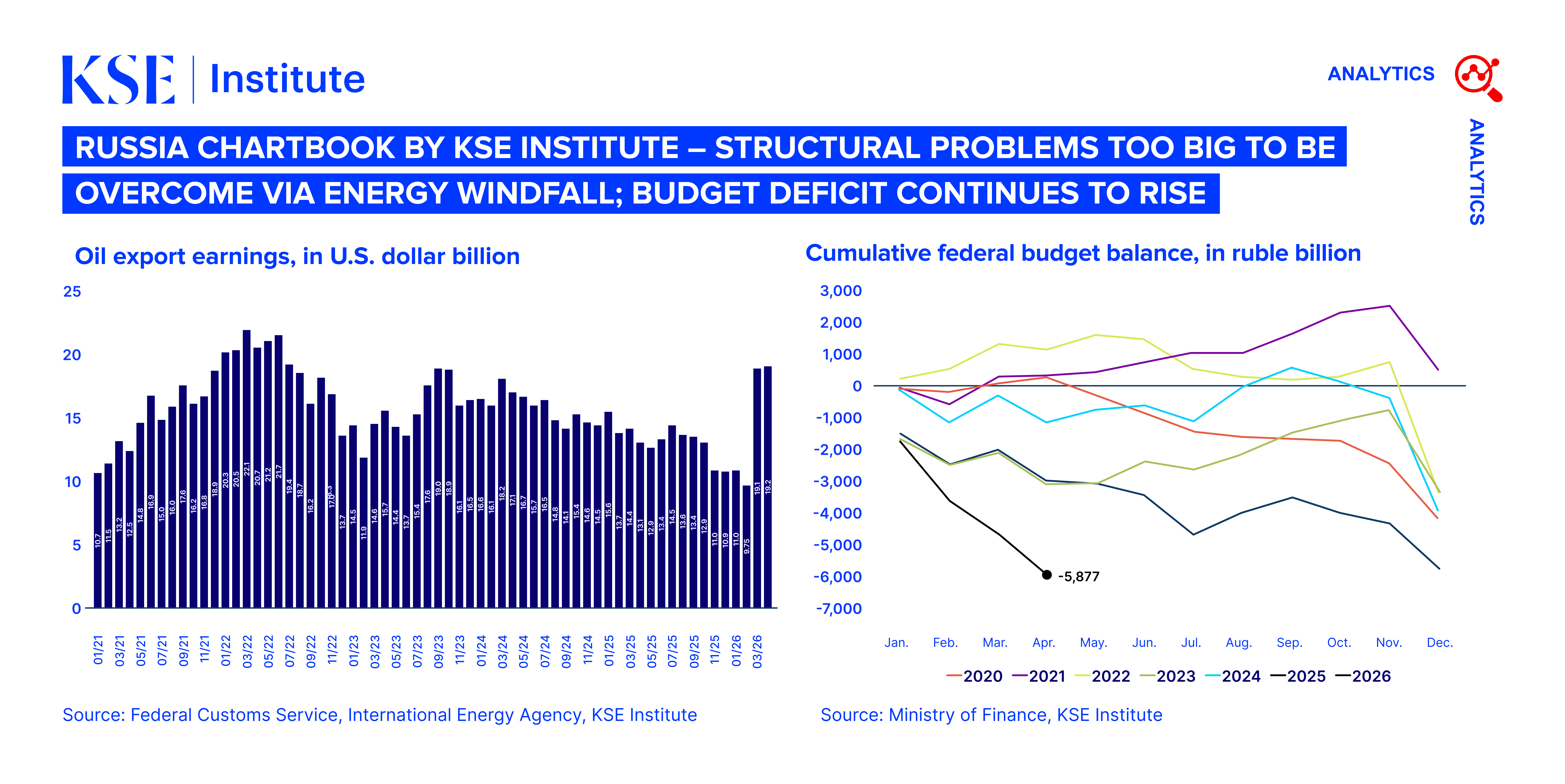
KSE Institute has published the May edition of its Russia Chartbook, “Structural Problems Too Big to Be Overcome Via Energy Windfall; Budget Deficit Continues to Rise.” The latest data show the Iran war’s impact on Russia’s oil revenues becoming increasingly tangible – but structural economic problems and a record budget deficit remain firmly in place.
The Iran war’s impact on Russia is growing more pronounced. Russian oil prices jumped sharply – from $43.7/bbl in January and $47.4/bbl in February to $78.3/bbl in March and $95.1/bbl in April. Export earnings followed, rising from an average of $10.4 billion in January-February to $19.1-19.2 billion in March-April. Because Russia’s tax system prices oil levies on the previous month’s price, higher prices only fed through to the budget a month later: in April, base oil and gas revenues doubled compared to March.
The earnings surge has also pushed the ruble to around 71 per dollar – its lowest since early 2023 – which, however, partially offsets the budget benefit, as energy revenues grow more slowly in local currency terms. Sanctions continue to cap any expansion in production volumes. Until energy markets stabilize after the end of the Iran war, Russia will keep receiving significant additional export and budget revenues.
Russia’s structural problems are too large to be solved by higher energy revenues. While oil and gas budget revenues rose sharply, revenues from other sources remain weak due to the economy’s stagnation. Spending continues to rise as more of the war’s cost falls directly on the federal budget. Higher energy prices have also increased the subsidies used to keep domestic fuel prices in check. April’s federal budget deficit reached 1.3 trillion rubles, bringing the cumulative January-April shortfall to 5.9 trillion rubles (~$75 billion) – double the level recorded a year earlier and already 55% above the full-year target. To cover the gap, the Ministry of Finance stepped up OFZ issuance and drew on NWF funds in Q1. These two channels, however, covered only part of the deficit – with a further $41 billion drawn from other sources, including Treasury accounts. As those balances decline with no improvement in sight, domestic borrowing and NWF drawdowns will need to increase in the months ahead.
Russia’s economy is grinding to a halt. After a sharp slowdown in 2025 – with real GDP growing just 1%, down from more than 4% in 2023-24 – Rosstat’s preliminary estimate for Q1 2026 shows a contraction of 0.2% year-over-year. Since this decline occurred relative to the weakest quarter of last year, the actual contraction was likely considerably larger. While war-related sectors continue to expand, the civilian economy is in recession: borrowing costs remain high and businesses are losing workers to the military sector. Inflation risks from Russia’s worsening fiscal position may prevent the CBR from cutting rates further, keeping elevated interest rates as a drag on private sector activity. Tight monetary policy has, however, delivered results – inflation has been brought under control.