
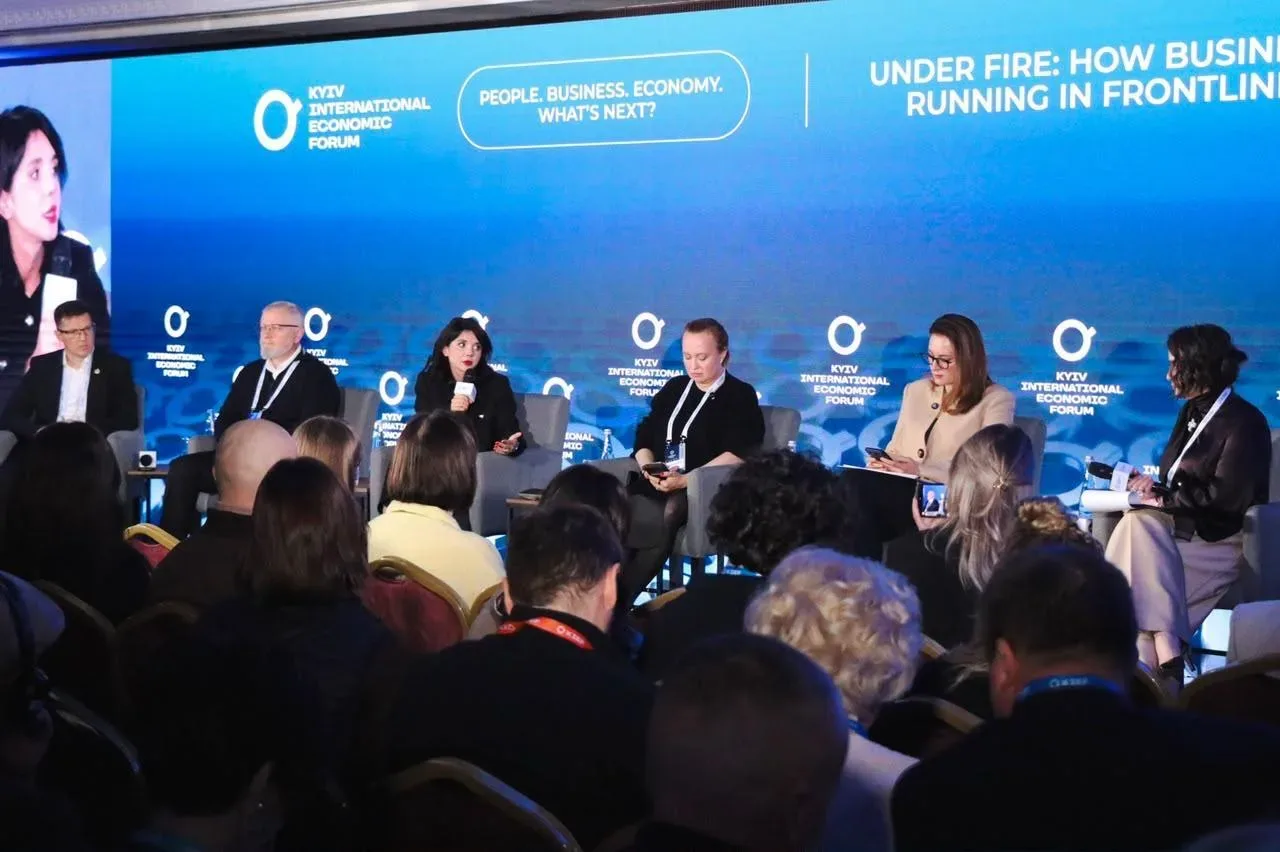
Ukrainian business is entering a new phase of the war, in which security risks, infrastructure damage and economic losses affect companies regardless of where they operate. How should businesses plan for growth under these conditions, and what support tools do they need? Yuliia Svyrydenko, President of KSE Business School, addressed these questions at the Kyiv International Economic Forum (KIEF). Here are the key takeaways from her speech.
Economic war: the new reality for Ukrainian companies
In the first nine months of 2026, Ukraine recorded 1,569 attacks on business facilities. Direct losses amount to $7.7 billion, including $3.3 billion in the energy sector and $2.4 billion in warehouse infrastructure.
These losses directly affect economic forecasts. According to estimates cited during the speech, Ukraine’s GDP may contract by 0.5% this year. Even the optimistic scenario projects growth of only 1.5%.
At the same time, the economic confrontation works both ways. KSE Institute estimates that strikes on Russian oil refineries have caused $20 billion in direct losses to the Russian economy, not including the cost of repairing damaged facilities.

The geography of threats is also changing. Physical protection of infrastructure used to be a priority mainly for frontline regions. Today, backup power, alternative water and heat supply, and protection of production facilities are needed across the entire country.
“Now all of Ukraine is a frontline zone. That is why business development scenarios and planning for next year must start from this understanding and include measures you may never have considered before,” said Yuliia Svyrydenko.
She identified underground construction as one of the promising areas. Zaporizhzhia, in particular, was among the first cities to gain experience in building underground shelters and safe spaces. For businesses, such projects require significant investment and therefore appropriate concessional lending programs.
Access to financing and war risk insurance
According to Yuliia Svyrydenko, the draft 2027 state budget retains business support programs, including the “Affordable Loans 5-7-9%” program.
However, financing remains uneven: 56% of the program’s funds go to Kyiv and the Kyiv region, while banks are reluctant to lend to companies in frontline regions.
Another priority is scaling up war risk insurance. According to data presented during the speech, the Export Credit Agency has received 240 applications for compensation to reduce the cost of insurance premiums. This is not enough for an economy the size of Ukraine’s. Expanding the program requires additional resources, including international funding.
Processing and new markets as growth opportunities
Despite logistics constraints, Ukrainian companies continue to adapt: they reroute supply chains and use Danube ports and rail transport.
For long-term growth, however, Yuliia Svyrydenko believes it is important to invest more actively in processing. Producing higher value-added goods not only increases the economic value of exports but also reduces the physical volume of cargo, which is critical when logistics are limited.
At the same time, the war is creating demand for new products and services, particularly in security. One example is the humanitarian demining market.
The President of KSE BS noted that experts initially estimated it would take 100–200 years to clear Ukrainian territory. That is why one of the solutions was to involve the private sector. Today, Ukraine has around 200 operators qualified to carry out humanitarian demining. The state provides regulation and certification, while private companies compete for contracts through a procurement system.