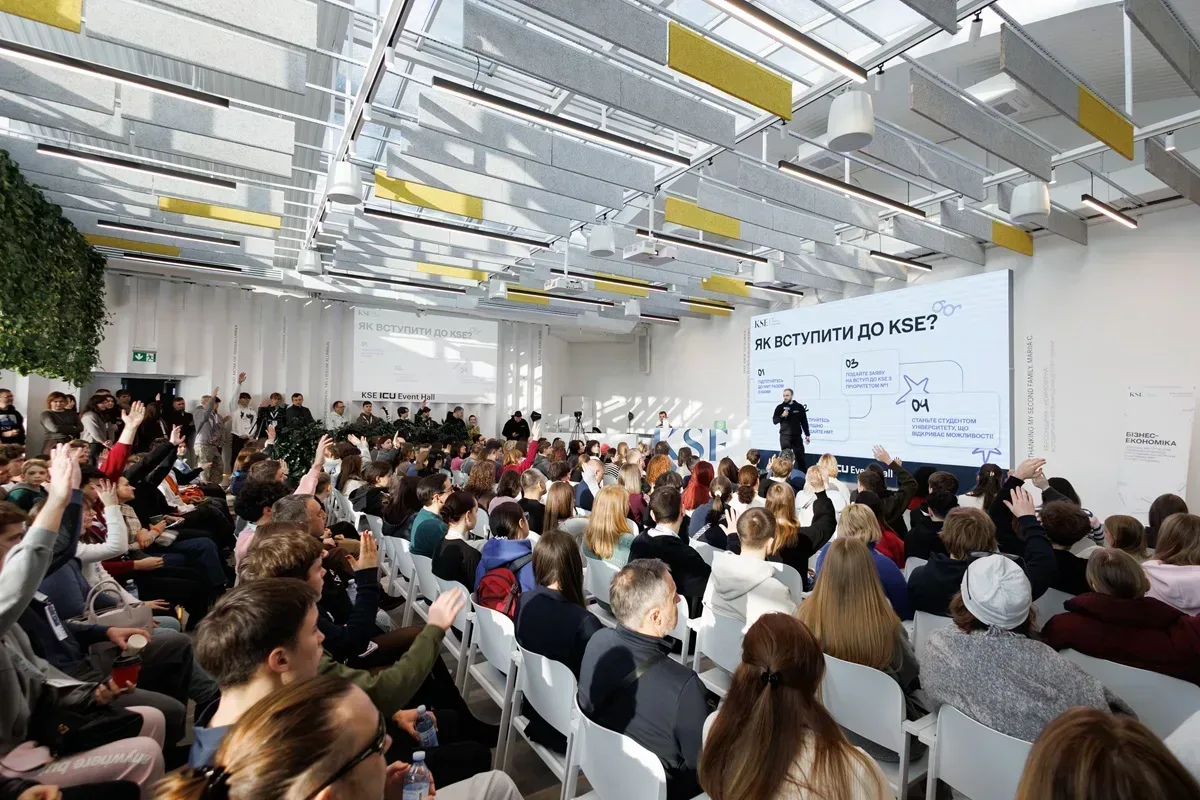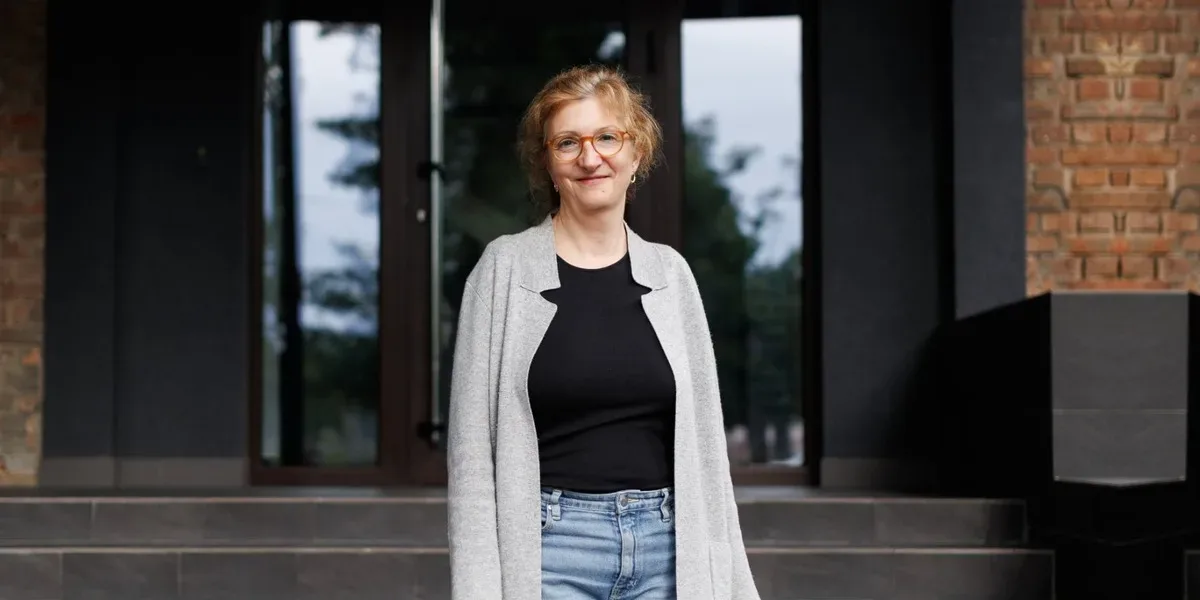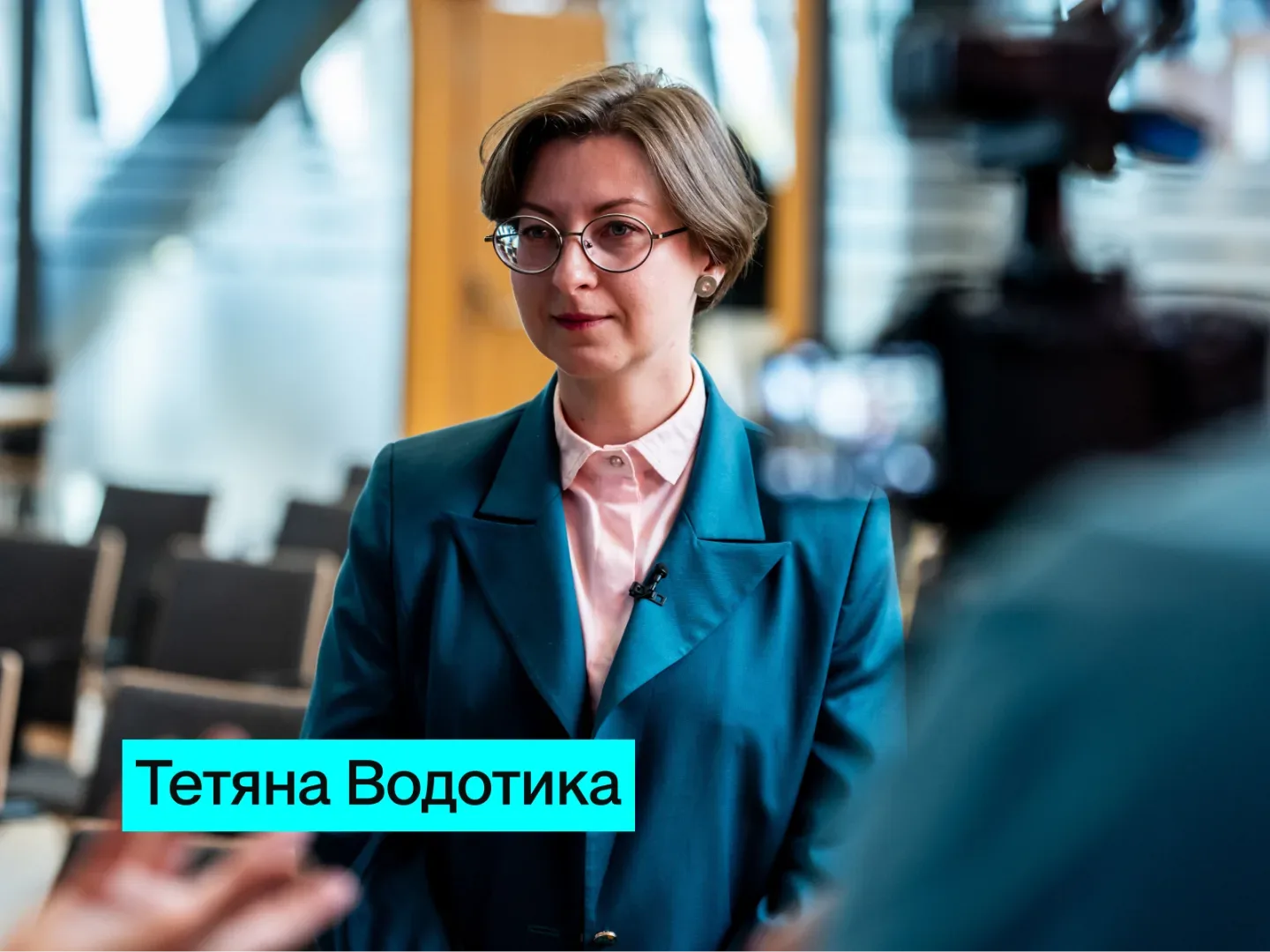
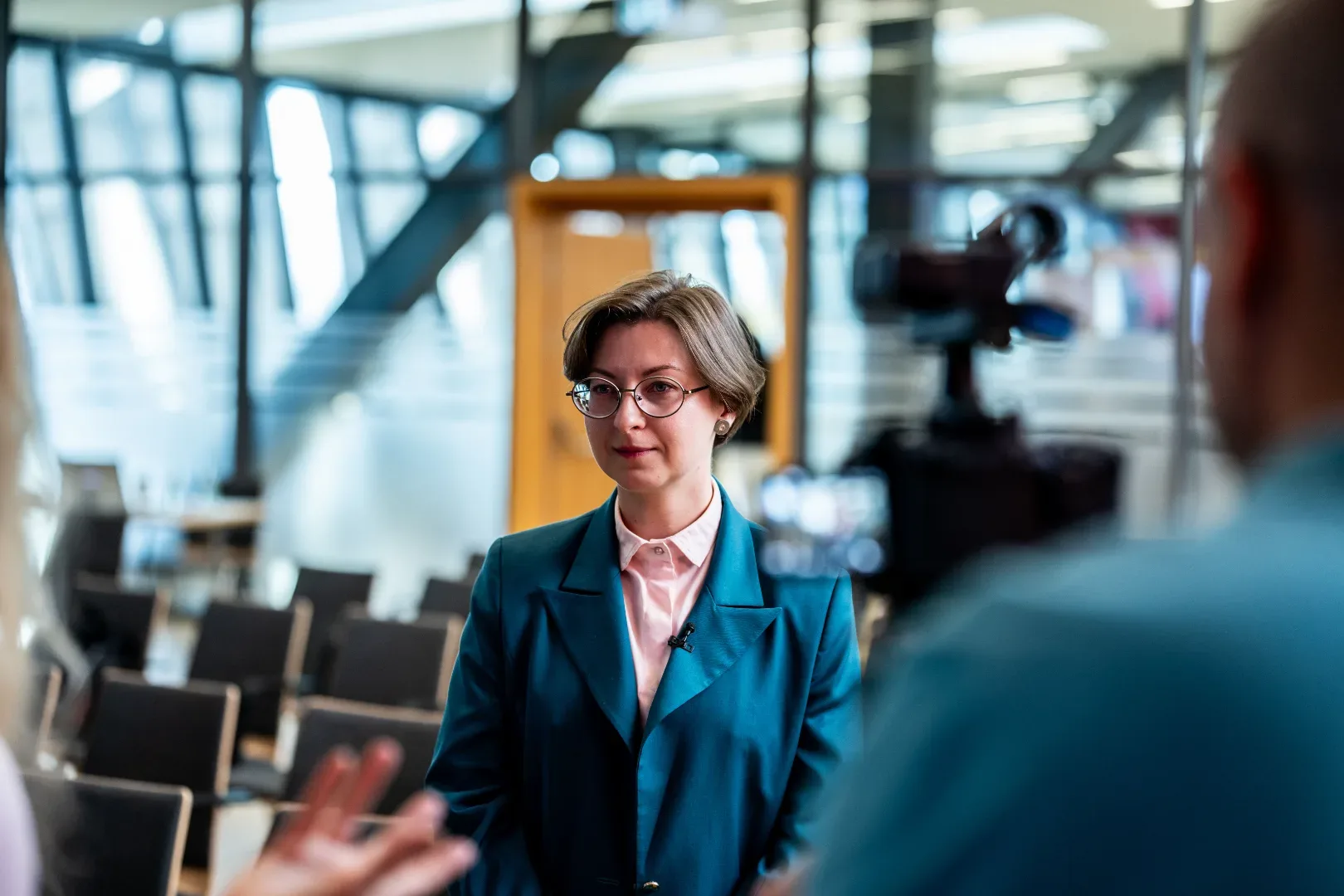
In early November, Tetiana Vodotyka, Academic Director of the Master’s Programme in Urban Studies and Post-War Reconstruction at KSE, spoke at Freedom of Research: A European Summit 2026. In her speech, she addressed academic freedom, the experience of Ukrainian researchers working during the war, the preservation of intellectual capital, and responsibility.
What is Freedom of Research: A European Summit?
Freedom of Research: A European Summit is an annual summit on research freedom held in Aachen, Germany. In 2026, it took place for the third time. The event is organised by the Charlemagne Prize Foundation together with the Knowledge Hub and the Käte Hamburger Kolleg: Cultures of Research (c:o/re) of RWTH Aachen University. Over two days, researchers, policymakers, and representatives of business and the public discussed how to protect research freedom in a Europe facing political polarisation, geopolitical tension and technological change.
This year, the summit focused on the link between academic freedom, innovation and Europe’s competitiveness, as well as the price society pays when research freedom is restricted.
Why does the summit matter for Ukraine?
For Ukraine, this platform has special significance: in 2023, the Charlemagne Prize was awarded to Volodymyr Zelenskyy and the Ukrainian people for their fight for freedom and European values. That is why any conversation about academic freedom in Aachen inevitably touches on the war Russia is waging against Ukraine, including against its science and education.
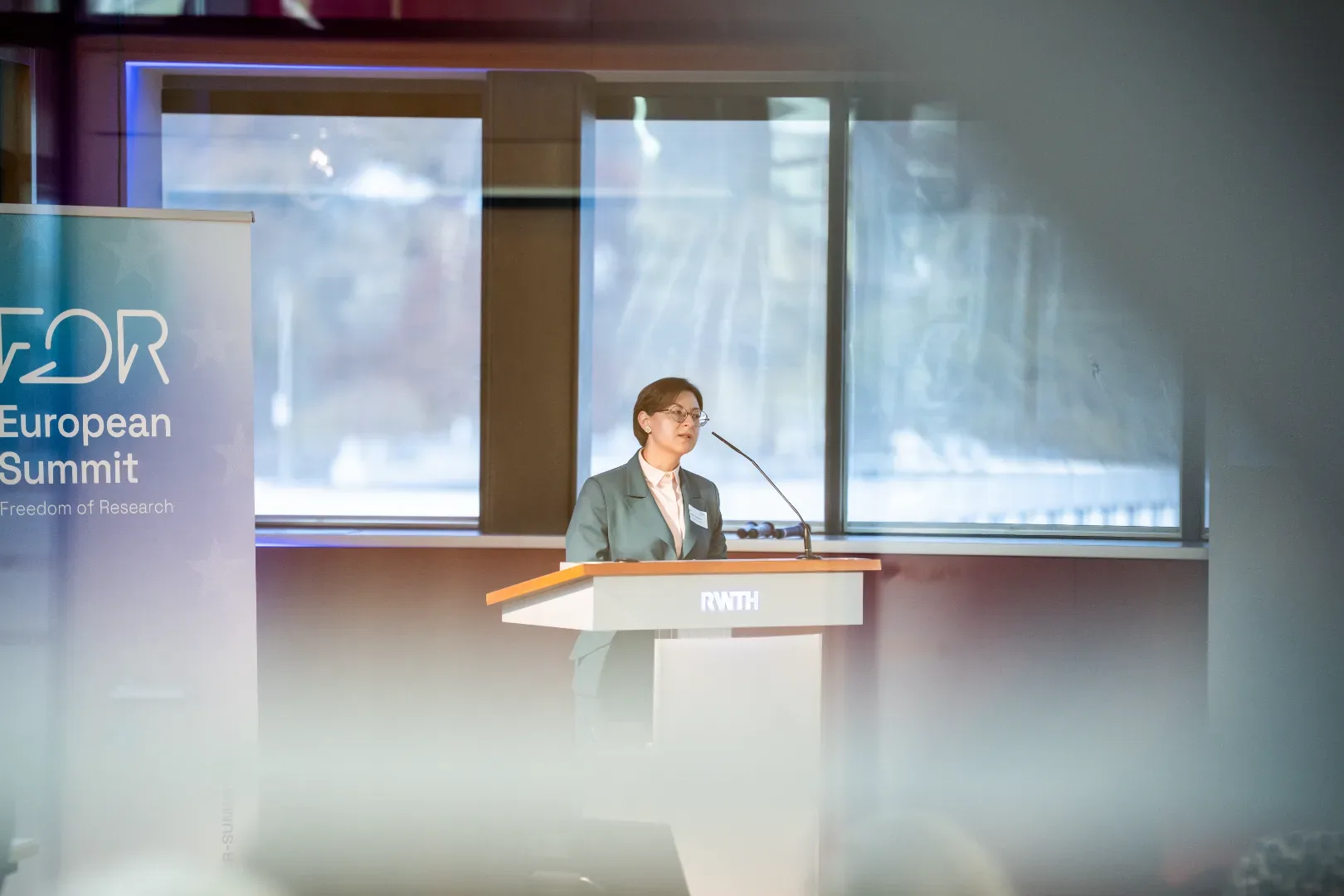
Tetiana Vodotyka, MA in Urban Studies&Urban Research Center, Social Sciences Department:
It was, as they say, the right kind of bubble, where people spoke honestly about threats to research freedom and to Europe as a whole. Some very non-obvious issues that affect our security were discussed openly and in depth. For example, what to do about the fact that 64% of the penicillin consumed in the EU is produced in China. How do we deal with that? It was very symbolic that these issues were discussed in Aachen, in the hall where the emperors of the Holy Roman Empire were crowned.
I was invited to speak about how academic freedom depends on survival in times of war. Of course, it does. But surviving does not necessarily mean being free. And sometimes the ultimate expression of freedom is the willingness to risk, or even sacrifice, one’s life for it.
Ukrainians know this from history. We lost our struggle for independence in 1917–1921. What followed was the Soviet regime, which executed the Holodomor, the Great Terror, and millions of lives destroyed by repression, terror and war.
This symposium opened with a keynote by Professor Carsten Reinhardt of Bielefeld University, titled “Innovation in a Totalitarian Regime: Historical Observations from National Socialism.” His historical examination of science and political power under the Nazi regime offered an important starting point for reflecting on academic freedom. Yet the history of academic freedom under Soviet communism deserves no less attention. And Ukrainian history offers a particularly telling example.
I spoke about Mykhailo Hrushevsky, the great Ukrainian historian, chairman of the Ukrainian Central Rada, one of the leaders of the Ukrainian Revolution of 1917–1921, and the man whose portrait appears on our 50-hryvnia banknote.
After the defeat of the Ukrainian People’s Republic, Hrushevsky went into exile. In 1924, he returned to Soviet Ukraine. Why? We will probably never know all his reasons. Perhaps he missed home. Perhaps he believed the promises of academic freedom and the opportunity to build his own school of historical scholarship. Perhaps he hoped that, despite the political circumstances, he could continue his life’s work and contribute to the development of Ukrainian historical research.
And for a time, he actually succeeded. Hrushevsky rebuilt a substantial school of historical research in Kyiv. He brought together scholars, mentored a new generation of historians, and developed ambitious research projects. He continued his work on Ukrainian history and helped create an intellectual community that could pursue research on Ukraine’s past.
But this intellectual flourishing was short-lived. The Soviet regime gradually dismantled his scholarly school. Researchers were subjected to political pressure, persecution, and repression. Hrushevsky died in 1934, having lived through the Holodomor. He did not live to see the Great Terror of 1937–1938, but his students and colleagues did. Many were arrested, imprisoned, or killed. His own daughter, Kateryna Hrushevska, an accomplished scholar herself, was arrested during the Great Terror and died in 1948 in the Gulag.
Some survived. But survival did not give them freedom.
Hrushevsky’s experience is a reminder that the opportunity to conduct research, even to build a flourishing scholarly institution, is not necessarily the same as academic freedom. Without the political and institutional conditions to protect it, that freedom can be taken away.
Today, a monument to Hrushevsky stands in central Kyiv, facing the historic building of the National Academy of Sciences of Ukraine, recently damaged in a Russian attack on 28 September 2026. Two people were killed. It is one of many Ukrainian academic and cultural landmarks damaged by Russia’s war. Laboratories, libraries, universities, and research infrastructure have been destroyed.
But these are buildings. Buildings can be rebuilt. Academia is not just walls. Academia is people.
Ukrainian academics have been displaced, forced into exile, and killed. Many have joined the Armed Forces. My friends and colleagues sometimes message me not from auditoriums or classrooms, but from the frontline. Just recently, I sent a picture from Aachen. In return, I received a picture of a puppy that had apparently joined their military unit.
They are alive. And I want them — and their puppy — to have something worth returning to.
This brings me to something we do not discuss nearly enough when talking about academic freedom: responsibility.
Freedom requires decisions, sometimes difficult and costly ones. And academia, as a social institution and a community, must have both a voice and the collective power to defend it.
In 2023, I joined the Kyiv School of Economics to establish and lead a master’s programme in Urban Studies and Postwar Reconstruction. It was not an easy decision. There were no shoes to fill. No ready-made model. And certainly not enough time for me to prepare for the role. I wish I had had more time, but I did not.
I also had to make a personal choice: to set aside much of my own research to build an education and research program (now a master’s programme in Urban Studies, accompanied by the Urban Research Centre). This is my share of the price of freedom.
I want to help build a genuinely free academic culture. One grounded in financial and intellectual independence, capable of defining its own research agendas, making its own decisions, and standing up for its values. A culture where international academic cooperation is about dignity, decency, quality, mentorship, and mutual support.
Not about knowledge and data extraction. Not about reproducing epistemic inequalities as new forms of domination. Not about treating Ukrainian researchers as convenient fieldworkers or research assistants who collect data for somebody else’s intellectual agenda. And certainly not about treating reconstruction as merely a construction contract.
Reconstruction is also research, learning, and co-production of knowledge. It is about building institutions capable of producing knowledge independently, questioning established hierarchies, and shaping their own futures.
Academic freedom cannot exist where academic communities lack the resources, independence, or collective capacity to exercise it. And it cannot be protected by individual survival alone.
That is why I believe the responsibility of academia goes beyond preserving individual careers, publishing papers, or even keeping universities operational during a war. It is about building institutions and communities that can protect freedom — including for those who are currently defending it elsewhere.
Freedom has my billing address. And its invoice never gets lost in the post.