Belgium’s French-language newspaper La Libre Belgique, one of the country’s oldest and most influential dailies, has published a report on how students and teachers in Kyiv continue their studies under bombardment. The author writes about KSE: underground classrooms, a hybrid learning model, scholarships, and a programme that helps Ukrainians return from abroad.
By Valentin Dauchot
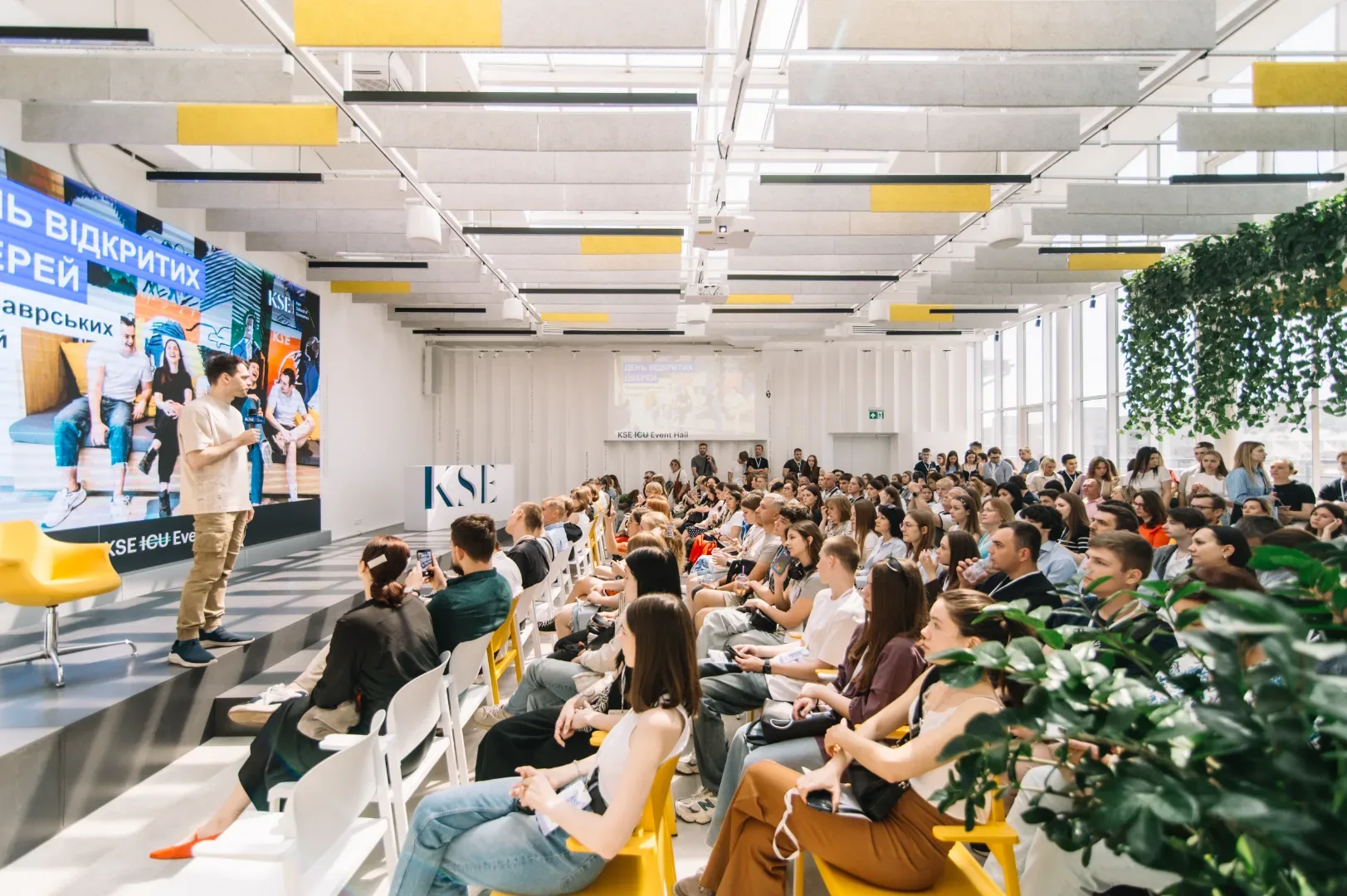
Ukraine. In the Ukrainian capital, universities are adapting to keep classes going despite the threat of bombardment. The Kyiv School of Economics in particular has developed substantial underground facilities.
“Sorry if you can hear noise, but I’ve just received a missile alert,” Dariia Zadorozhna says calmly from one of the classrooms at the Kyiv School of Economics (KSE) equipped with a shelter. “Every classroom where students attend in person has a shelter in the basement, where we can continue classes in case of danger. If this alert is confirmed, other students will probably join me.”
Originally from Vinnytsia, a few hours’ drive from the Ukrainian capital, the 20-year-old student is starting her third year in the artificial intelligence programme despite the ever-intensifying Russian attacks. “There are a lot of drones over the city now, but in the end the brain gets used to the danger. I used to be scared of a yellow alert. Now a red one is part of everyday life.”
Grants for Military Families
In March 2022, two weeks after the Russian invasion, the Kyiv School of Economics (KSE) resumed classes online. Six months later, the university brought students back to classrooms equipped with generators, Starlink internet access, solar panels, and water and food supply systems in case of an attack or a prolonged power outage. In 2021, this then-small private university had 362 students; today, it has nearly 2,500. This growth was driven, among other things, by its safety infrastructure, funded through an international fundraising campaign.
“More than half of our students receive tuition grants,” explains Vice President Mykola Trehub. “First and foremost, we support students with high academic achievements, those forced to leave war-torn regions, children of military personnel, and Ukrainian students who have decided to return from abroad.”
“Before the invasion, around 75,000 Ukrainians were studying abroad,” he adds. “In 2024, there were 115,000, mostly in Germany and Poland. We don’t know how many of them have returned to Ukraine since then, but there are grants that help them come back and receive financial support, such as the KSE Come Back Home program.”
“I really liked Belgium, but I felt the need to return”
Ivan Yazykov is one of those students. In 2024, “after two years of war,” he left Kyiv for Ghent. “I really liked it there,” he says over the phone. “It was the right decision. But despite the good living conditions and new friends, I just couldn’t stop thinking about Ukraine. The more time passed, the harder it became for me. I was too far from my loved ones, too far from my roots. Eventually, I realized: my place is here, no matter the circumstances.”
This summer, thanks to a KSE grant, he returned to Kyiv to continue his studies in a hybrid format. “If an attack happens in the morning, classes are held online. If it starts when we are already at the university, classes continue in the shelters. All students have a choice: to study remotely or to attend classes in person. This is quite a rare opportunity, as most universities conduct their entire educational process remotely. Personally, it is important for me to see people and socialize.” At 20 years old, he is studying psychology, “because in the future, many Ukrainians will need help.”
The Kyiv School of Economics offers a solid education in the humanities, but the Russian invasion has inevitably changed the needs of the country and the labor market. “The demand for engineers and construction specialists is growing rapidly,” notes Vice President Mykola Trehub. “In 2024, we opened an Engineering School with programs dedicated to micro- and nanotechnologies, ground, sea, and aerial drones, electronic microchip design, and civil engineering. In addition, we have expanded our educational programs in law, psychology, cybersecurity, artificial intelligence, and applied mathematics to meet these needs.”
“I decided to sleep”
During the first years of the war, the Ukrainian capital was relatively protected, but in recent months, it has been enduring heavy strikes. “I was thinking about this recently,” says Dariia Zadorozhna. “My first years in Kyiv were completely different. It was calm and pleasant. There weren’t so many drones, bombs, and missiles. Now the threat is constant, so I decided to sleep—literally. Because of the drones and air raid alerts, there are so many nights when anxiety overwhelms me, yet I decided to stay in bed and no longer go to shelters. I have a lot to do during the day, so it is crucial for me to rest.”
The escalating threat is one of the reasons why the Kyiv School of Economics developed a hybrid learning format, giving everyone the choice to stay home or come to class. “I am afraid for Kyiv,” the young woman continues. “I am afraid it will become empty, gray, and sad, with destroyed buildings and a mass outflow of people to other cities.”
Ahead of a winter that could be particularly dangerous, KSE is not giving up and assures that it is “taking all measures to adapt schedules and class formats” in the event of massive Russian attacks. “We strive to preserve the opportunity to study and come to the classrooms, but student safety is our absolute priority. Every decision will depend on the intensity of the attacks and available resources. Last winter, these measures allowed the university to save 15,000 hours of teaching and learning. We hope that this year, the result will be at least the same.”
Original article on La Libre Belgique