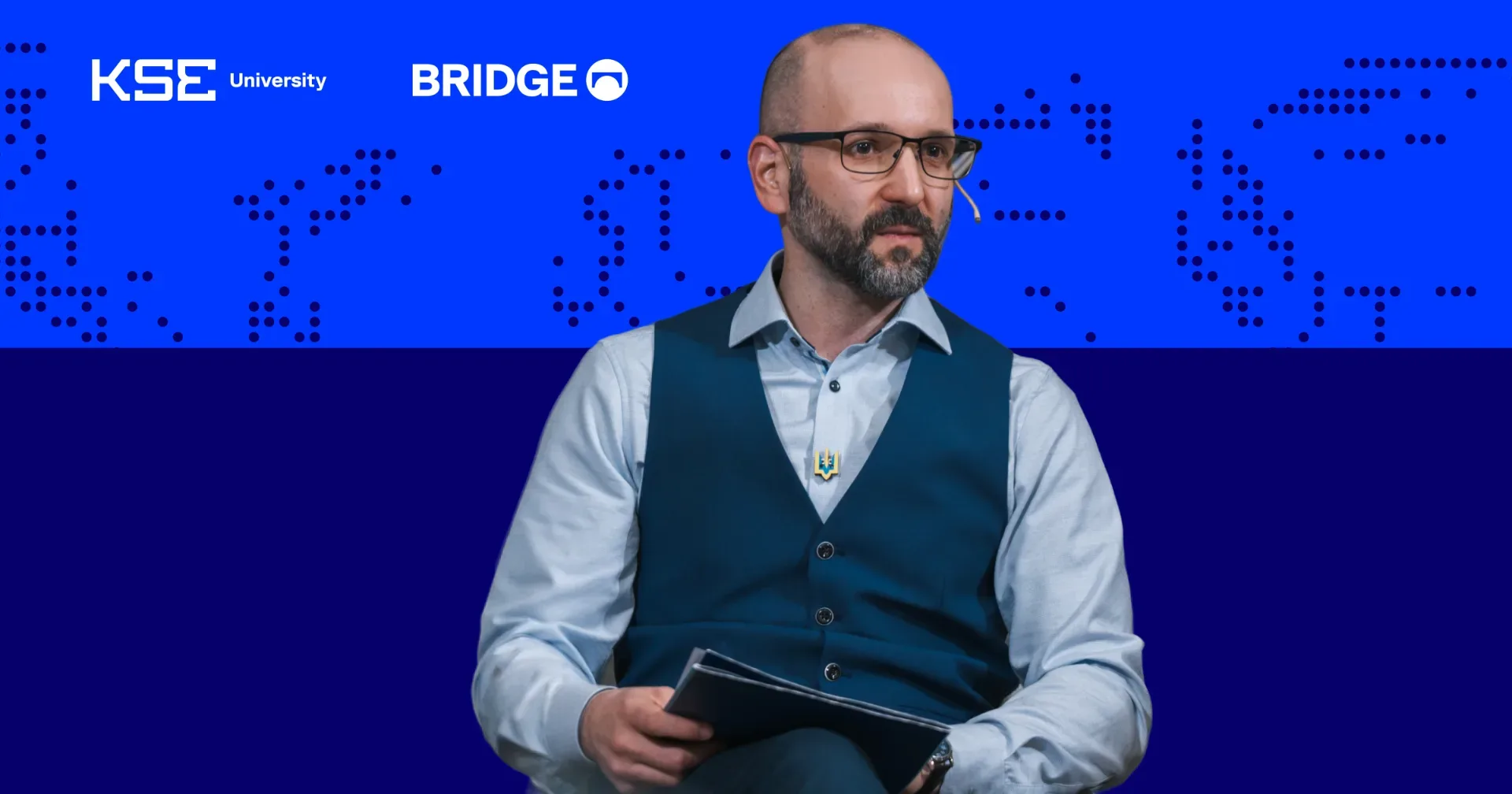
Dmytro Khutkyy, scientific lead of the BRIDGE project at the University of Tartu, spoke about digital governance to students of the Public Policy and Governance program at KSE University. He showed them how Ukraine, Estonia, and other countries use data and artificial intelligence, maintain citizens’ trust, and make digital services inclusive.
Dmytro Khutkyy heads the Ukrainian Centre at the University of Tartu, works as a research fellow in digital governance, and holds a PhD in Sociology.
His talk opened a series of guest lectures within the BRIDGE project, which KSE University coordinates under the EU’s Horizon Europe programme. Through these lectures, KSE University and the project partners (the University of Tartu, Erasmus University Rotterdam, and Technische Universität Berlin) share experience and strengthen each other’s research capacity.
Key takeaways from the lecture:
-
Every challenge in digital governance has a matching solution, depending on what we choose to focus on. Transparency strengthens trust in digital services: in Estonia, for example, anyone can check who accessed their data and when. In Ukraine, participatory budgeting involves people in decision-making: unlike petitions, its results are binding on local governments. According to Dmytro’s research, communities have implemented about 80% of the winning projects.
-
Digital governance involves perennial dilemmas that each country resolves in its own way. Germany, for instance, prioritizes stability and keeps paper-based processes, while Estonia invests in digital experimentation. The two paths differ in the resources they require, their speed, and their risk. Estonia considered using Ukraine’s Diia as a basis but eventually chose to develop its own mobile e-services app.
-
The digital state will ultimately become an agentic state. Diia already delivers services through chatbots and AI agents, and such automation can make government processes more efficient. At the same time, the data and logic behind a model may remain opaque, and approaches to migration and human rights may depend on the values embedded in the model a state chooses. That is why humans must stay in control of the model and understand how it produces its results.
“It was interesting to hear the vision and experience of digital governance that KSE students have, and to connect it with academic and applied research in this field,” Dmytro said after the interactive lecture.
The BRIDGE project is implemented by the Kyiv School of Economics (KSE), Erasmus University Rotterdam (the Netherlands), Technische Universität Berlin (Germany), the University of Tartu (Estonia), and the Center for Innovations Development (Ukraine), and is funded by the European Union under the Horizon Europe research and innovation programme. The publications reflect only the views of the project.